|
This version is still in development and is not considered stable yet. |
Performance and Throughput
Figures below come from the framework’s own internal benchmarks - a single-machine measurement (8-core, JDK 25), not a certified reference number for every workload. They are meant to convey order of magnitude and, more importantly, when concurrency actually helps, not an exact figure to expect on your own hardware.
Per-hop overhead (JMH microbenchmark)
The cost of the framework’s own bookkeeping around a single Exchange, independent of anything a
flow’s Processor itself does:
| Operation | Average cost |
|---|---|
|
~2-11 ns |
Advancing to the next node ( |
~253 ns |
Creating or copying an |
~500-505 ns |
For context: a flow with 3 processor steps pays roughly 1-1.5 µs of pure framework overhead per message, before any of the step’s own logic runs.
End-to-end throughput and concurrency
Measured on a synthetic 3-step pipeline (cheap, non-blocking processors) fed through
fromSource("queue://…?concurrency=N"):
concurrency |
Throughput |
|---|---|
|
~360-385k msg/s (baseline) |
|
Worse than the default - as low as ~90k msg/s |
|
~495k msg/s - the first value to clear the baseline in this measurement |
|
~555k msg/s |
|
~560-575k msg/s (plateau, bounded by the machine’s core count) |
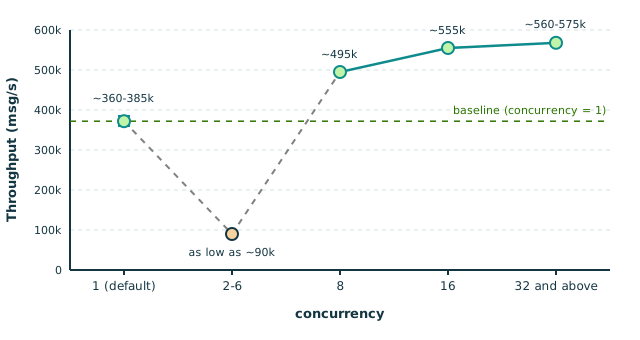
The dip in the middle is real, not noise: dispatching a message to a worker thread has a fixed cost (acquiring a permit, submitting to the shared pool) that a cheap processor’s own work does not amortize until concurrency is high enough to keep pool threads consistently busy rather than repeatedly parking and waking up.
Practical guidance:
-
The processor waits on something external (an HTTP call, a query, another queue) -
concurrency > 1almost always helps, even at high values: a thread blocked on I/O costs no CPU, so others can run on the same cores. -
The processor genuinely computes (a heavy transformation, crypto, parsing) - it helps up to roughly the number of available cores; beyond that, oversubscription costs more than it gives back.
-
The processor is cheap (a field mapping, a trivial check) - leave
concurrencyat its default of1unless you have measured a genuine gain; the fixed per-message dispatch cost otherwise outweighs the work itself, exactly as in the table above. -
A downstream bottleneck (a database’s connection pool, an API’s own rate limit) caps throughput regardless of
concurrency- raising it past that point just moves the queue elsewhere.